Showing posts with label Books and Authors. Show all posts

Wednesday, June 24, 2026

How does the depreciating rupee affect one’s personal savings and finances? A new book explains it

This article was first published in the Scroll. 

https://scroll.in/article/1093589/how-does-the-depreciating-rupee-affect-ones-personal-savings-and-finances-a-new-book-explains-it

An excerpt from ‘The Economy Is Personal: How Big Economic Forces Shape Your Money – And What You Can Do About It’

Have you ever heard someone say, “The rupee is falling against the dollar”? It might sound like financial jargon, but it actually has a very real impact on your day-to-day expenses – even if you’re not travelling abroad. Let’s break it down.

Every country has its own currency. When countries trade with each other, they need to convert their currency into the other’s. So, for example, if India wants to buy something from the US – like crude oil, electronics or machinery – it has to pay in US dollars, not rupees.

Today, 1 US dollar = Rs 75. But next month, 1 US dollar = Rs 80.

This means the rupee has weakened, depreciated or lost value compared to the dollar. Earlier, India needed Rs 75 to buy something worth $1. Now, it needs more rupees, that is, Rs 80, to buy the same thing. That extra Rs 5 has to come from somewhere – and that “somewhere” is your wallet.

So, when the rupee weakens, imports become more expensive, because we need more rupees to buy the same goods from abroad. And since India imports many essential items, like fuel, cooking oil, smartphones, and electronics, those prices go up for everyone. This increase in prices contributes to overall inflation.

Think of it like shopping at a store where the price tag is in dollars. If your rupees are worth less each week, you’ll have to spend more to buy the same things.

That’s why economists and policymakers closely watch the exchange rate. A weak rupee can make imported goods expensive, and that, in turn, can raise prices across the economy – even for things made in India, because transport and input costs can go up.

Why does a falling rupee make your grocery bill heavier?

Because when imported goods and transport get pricier, those costs ripple through the entire supply chain. When the rupee drops, even your shampoo bottle, bus ticket or smartphone can feel the pinch.

So … What does the exchange rate have to do with the price of milk? If fuel prices rise due to a weaker rupee, transport costs go up and, suddenly, your morning milk costs Rs 2 more.

Inflation refers to the rate at which the prices of goods and services rise over time. In India, this is most commonly measured using the consumer price index (CPI). It is a statistical measure that captures the average change in prices of a fixed basket of items, such as food, fuel, clothing, housing and healthcare, that households typically consume. The base year, currently 2012, is assigned a CPI value of 100. All subsequent values show how much prices have risen since that year.

CPI in 2024: 190. CPI in 2025: 194

This means that prices in 2025 were 94% higher than in 2012. But to find inflation for one year, we look at the rate of change between the two years.


So, inflation is 2.11%, even though the CPI level is 194. The CPI tells us prices are almost double what they were in 2012, but the year-on-year increase is what we refer to when we say that inflation is 2.11%.

The Ministry of Statistics and Programme Implementation (MoSPI) publishes CPI data every month. The RBI monitors it closely to make interest rate decisions. If CPI rises sharply, even due to something like a tomato price spike, it can prompt the RBI to raise interest rates, which affects loans, EMIs, savings returns and overall economic activity.

Can everyday consumers affect global inflation?

Absolutely. When millions of people suddenly start spending more (like after the Covid-19 lockdowns), businesses struggle to keep up with demand. As we saw earlier, this pushes prices higher and is known as ‘demand-pull inflation’. For example, when Americans began “revenge spending” in 2021, global supply chains couldn’t catch up, which drove up the prices of electronics, furniture, fuel and even shipping containers. What you buy, how much and when – these choices affect the entire economy.

Now let’s bring this back to your wallet. Where does Rs 10,000 go in five years?

Similarly, suppose you save Rs 5,000 every month for ten years in a savings account that earns 3% interest. By the end of ten years, you’ll have saved about Rs 7 lakhs. Sounds like a decent amount, right?

But now imagine inflation has averaged 6% during that time. To buy the same things you could have bought with Rs 7 lakhs ten years ago, you would now need over ₹9 lakhs.

So even though your savings have grown in number, their real value has shrunk. That’s the silent, invisible power of inflation – it eats into your future, rupee by rupee.

And this affects your dreams:

The house you planned to buy: Now out of reach.

The college education you thought you’d covered: Now costs double.

The retirement you hoped would be peaceful: Suddenly feels uncertain.

This is why just saving isn’t enough. You need to make your money grow faster than inflation, and that means you’ll need to invest. But every investment carries uncertainty. Risk isn’t something to fear; it’s something to understand.

Monday, March 9, 2026

Behind the Metrics: The Human Story of Entrepreneurship


This Book Review was first published by Forbes India on March 9, 2026; https://www.forbesindia.com/article/life/behind-the-metrics-the-human-story-of-entrepreneurship/2992056/1

Book Review: Unseen: The Untold Story of Deepinder Goyal and the Making of Zomato by Megha Vishwanath

Penguin Business, 332 Pages

In Unseen, Megha Vishwanath tells more than the story of a startup. She traces the making of Zomato alongside the making of its founder, Deepinder Goyal, placing both within the turbulence of India’s startup ecosystem. The book follows Zomato’s journey from an idea to a platform that reshaped urban consumption. Vishwanath attempts to move beyond hero worship (though not always successfully), and instead circles a harder question: what actually sustains a company once charisma alone is not enough?

Restlessness beneath recognition

Early in the book, Vishwanath asks, “…what happens when you finally become visible to the world… and still feel unseen by yourself.” She closes with, “Strangers recognised his face everywhere. But here, where it mattered most… he had disappeared.”

Read together, these lines capture the emotional truth of entrepreneurship: a restlessness that achievement cannot settle, and recognition that does not quiet the inner noise. Even after building at scale, much remains beyond one’s grasp. Vishwanath treats this not as contradiction but as condition, the human cost of ambition. Success does not resolve uncertainty. It merely changes its shape.

This is one of the book’s quieter strengths. It allows us to see the founder not only as builder, but as someone perpetually in motion, driven less by arrival than by unfinishedness.

Talent density, not founder mythology

One of the book’s most compelling insights is that Zomato’s edge was never just its founder’s drive. It was the depth of talent Goyal cultivated. Over time, he built what can only be described as a bench of founder-quality leaders, people capable of matching his momentum rather than merely executing instructions.

The organisation that emerges is not tightly hierarchical. It is loosely networked, powered by ownership and speed. Vishwanath captures this internal architecture well, showing how momentum becomes distributed rather than concentrated.

Yet here the book leaves an unresolved tension. While Vishwanath emphasises distributed leadership, the narrative remains deeply anchored in Goyal’s judgement and instinct. One comes away reassured about talent, but less certain about institutional durability. If the founder’s presence were to recede fully, would the culture hold? 

This feels especially relevant today. As of February 1, 2026, Goyal has stepped down from the executive role of CEO to focus on new ideas. At 43, he remains central to the company’s identity, still perceived as the connective tissue holding things together. Yet the book leaves behind a productive anxiety: who sustains such a fluid organism when its most catalytic presence recedes? Would Eternal endure if, hypothetically, Goyal ever decided to disappear to the mountains?

Capital with conscience

Vishwanath is clear-eyed about the startup ecosystem itself. Funding cycles, boardroom pressures and valuation swings are described without melodrama. In Zomato’s case, Sanjeev Bikhchandani, founder of Naukri.com and an early investor, emerges as a stabilising force.

More than capital, he brought governance, perspective and restraint. His role illustrates something important: when ambition is paired with experienced counsel, growth becomes more grounded. 

Communication as leadership

A particularly valuable thread in the book is the treatment of communication as leadership. Goyal’s letters to employees are a master class in clarity and transparency, especially the one outlining the qualities that define a founder’s mindset. Ownership. Speed. Intellectual honesty. Long-term thinking.

There is no ornamental language, no managerial fog. Just shared vocabulary and shared standards. In an ecosystem where ambiguity often masquerades as strategy, these letters show how culture is built deliberately, through words that people can internalise. Institutional depth, Vishwanath reminds us, does not come only from hiring talent. It comes from facilitating that talent to continuously push boundaries.

Risk, relationships, and orchestration

The book also captures the cultural risk embedded in entrepreneurship. For those shaped by predictable career paths, leaving a firm like Bain for uncertainty feels irrational. Vishwanath does not romanticise this leap. She shows the isolation, the strain on family and friendships, and the faith required to persist when outcomes are unclear. She also honours the invisible ecosystem around founders: parents who tolerate risk, friends who absorb volatility, early employees who commit before proof.

Zomato is often criticised for not having “invented” anything. Vishwanath offers a quieter rebuttal. Innovation is not always technological novelty. Zomato reorganised information, reduced friction, and saved time. Today, when bandwidth is limited and traffic relentless, that matters. Convenience, here, is structural.

The unseen work behind endurance

Most founder biographies, whether Ronnie Screwvala’s Dream with Your Eyes Open or global accounts like The Everything Store- Amazon or Shoe Dog- Nike, often reflect on companies that have already stabilised into institutions. They emphasise systems, scale, eventual clarity, and the founder who has himself become an institution or a steward.

Unseen operates in a more unsettled space. Zomato, at 17, is neither fledgling nor fully mature. It behaves with the urgency of a startup despite its scale. Unlike many managerial accounts of company building, Vishwanath goes inward. She examines the founder’s psychology, the proximity to failure, the strain on relationships, and the role of family and friends as silent partners in risk. 

She looks into the mind of a founder, who remains in the restless start-up founder phase. That interior focus distinguishes the book. 

Conclusion

At times Unseen reads like a fast-paced corporate thriller. But its deeper contribution lies in what it says about leadership and institution-building. It shows how governance and chaos coexist, how capital needs conscience, and how communication becomes culture.

And then it leaves you with a harder truth. The real test of ambition is not how brightly it burns in one individual. It is whether it can be distributed, absorbed, and carried forward by many. That is the unseen work behind every enduring enterprise. And that, ultimately, is what this book is really about.

Friday, December 13, 2024

Legacy in Action: Continuity, Storytelling, and Archiving at the TATAs

This Book Review was first published in the Economic Times, December 13, 2024; https://economictimes.indiatimes.com/news/company/corporate-trends/legacy-in-action-continuity-storytelling-and-archiving-at-the-tatas/articleshow/116273631.cms?utm_source=contentofinterest&utm_medium=text&utm_campaign=cppst


In Jamsetji Tata: Powerful Learnings for Corporate Success, R. Gopalakrishnan and Harish Bhat provide an intimate view into the Tata Group’s legacy, revealing the values and vision that have helped this family enterprise endure across generations. This book benefits from the insider perspective of authors who have “lived” within the Tata ethos. Throughout the book, three core principles stood out to me for their relevance to family businesses everywhere: continuity, storytelling, and archiving. Through these pillars, the Tata Group has not only survived but has actively contributed to India’s growth story for over a century.

Continuity as the Backbone of Purpose

In family businesses, continuity is the anchor that keeps purpose alive. The Tata Group is a compelling case in point, where continuity is not a passive inheritance but a deliberate practice. Jamsetji Tata envisioned an institute of higher education in India and his son, Dorabji Tata, carried this vision forward by establishing the Indian Institute of Science, a foundation for India’s scientific advancement. Later leaders, like Naoroji Saklatwala and Ratan Tata, stayed true to Jamsetji’s goals by expanding the group’s initiatives in healthcare, education, and rural outreach, including regions like the underserved Northeast.

What emerges through Jamsetji Tata is an argument for continuity as more than tradition; it is an evolving legacy that serves as both compass and anchor. Without continuity, iconic Tata projects like the Cancer Research Institute or the Northeast Initiative could have easily become fleeting ventures. Instead, they are legacies, continually renewed by successive leaders. The Tata story suggests that if family businesses seek to last, their purpose must be deliberately preserved and adapted across generations.

The Role of Storytelling in Building Legacy

Gopalakrishnan and Bhat show that in Tata’s journey, storytelling has played a central role in transmitting values and keeping the organization’s mission alive. In business, it’s easy to lose sight of purpose, but stories—especially those that explain the “why” behind values—make those principles memorable and accessible. Storytelling within Tata has preserved a cohesive narrative, reinforcing the organization’s commitment to community, integrity, and resilience in the face of adversity.

Consider the story of Mithapur, a drought-stricken settlement in Gujarat that Tata helped turn into a thriving township. In today’s era, where discussions often revolve around work-life balance, the dedication that went into transforming Mithapur may seem almost unimaginable. Tata’s story in Mithapur illustrates what’s possible when companies invest beyond profit, in places that need development. They offer insights into the ethos of purpose-driven enterprises and inspire budding entrepreneurs to envision business as a force for societal good.

As the spouse of an entrepreneur, the story of Dorabji Tata and his wife Meher Bai, who pledged their entire wealth to save Tata Steel, resonates deeply with me. I know how tough these decisions are. Tata’s stories don’t merely showcase business achievements—they reveal the spirit of sacrifice and conviction that make up the core of the organization’s legacy. And, storytelling isn’t just a tool for marketing but a way to instill values that resonate across generations and communities.

Archiving as a Pillar of Organizational Memory

Perhaps the most understated yet powerful aspect in Jamsetji Tata is the emphasis on archiving as a tool for continuity. By meticulously preserving letters, speeches, and records, Tata has built a repository that keeps its past connected to its future. This archive doesn’t just record facts; it captures lessons, insights, and the reasoning behind key decisions, providing a resource for current and future leaders alike, cultivating a living memory.

For other family businesses, the Tata archive is an inspiring model, underscoring how documenting history and values can build a lasting legacy. Preserving history this way is more than nostalgia; it’s a strategic resource that reinforces Tata’s purpose, ensuring that its ethos remains as powerful today as it was a century ago.

A Blueprint for Family Businesses Seeking Enduring Success

Taken together, continuity, storytelling, and archiving create a framework for sustaining purpose over generations. Gopalakrishnan and Bhat’s account is both a tribute to Tata’s rich history and a guide for family businesses grappling with the challenge of building a legacy that lasts. This book invites business families to consider how they might nurture a shared purpose, disseminate stories that resonate across generations, and preserve the lessons of the past for future growth.

Through their insider perspective, Gopalakrishnan and Bhat reveal that in a world often consumed by the pursuit of growth and innovation, Jamsetji Tata is a timely reminder that true legacy is not merely built, but carefully tended—through continuity in purpose and values, storytelling, and preservation. The authors offer an enduring truth: success may be measured in quarters, but legacy is crafted across centuries.

Sunday, May 5, 2024

A Country Called Childhood

When reading "A Country Called Childhood- A Memoir" by Deepti Naval, I became nostalgic and reminisced about my childhood. I recall the Shree Ji stores in Ramgarh which used to be my favorite shop. It rented out comics for Re 1 a day. Sometimes 4-5 Amar Chitra Katha or other comic books would be bound together and they would charge a slightly higher amount for renting it. Ramgarh did not have a library and that store filled the gap for me. They also had various candies and gift items that used to fascinate me.

I also recall the samosas and sweets of Rajasthan Kalewalaya and their dahi kachori on special occasions. Later, when I was slightly older, they started selling a sweet called Madhuchakra that became my favorite.

Priya Sweets was for special occasions. Especially when I went to the main road and the elder accompanying me was in a good mood and had a few extra rupees to indulge me. There used to be the occasional curry puff, pineapple pastry, and beetroot cutlet.

Then Mangal Singh's shop was perhaps the most aspirational shop. You went there to buy an odd pencil box or water bottle. But there were so many things I liked. There used to be games, fancy tiffin boxes, or water bottles, that were often out of bounds.

For as long as I recall, we bought dresses only from National Stores. It was a very fancy store for it's times. It looked glossy, clean, and neatly arranged. We bought very few dresses but bought only from there. In hindsight, it seems like a lesson in quality over quantity.

One distinct memory I have of Ramgarh during my growing up years is the mela that used to be put up every year during December and would go on till Jan 26th. It used to have the Maut ka kuan, the Ferris wheel, a circus, and various shops selling toys, clothes, utensils, etc. There is a memory of buying iron utensils such as kadhai and tawa from there on more than one occasion and getting the knives sharpened. I also remember buying Khaja- a sweet- that I used to love eating, from there. Mounds of colourful sweets on both sides of the road. But we would buy the Khaja and occasionally Balushahi. I remember going to this mela 3-4 times during the one month that it was there, every year.

Another favorite shop of mine was Sishu Gyan Kendra, and later its sister concern, Gyan Bharti. We would go there for all our stationery, notebooks, and books. I remember the rolls of brown covers and the carefully selected book-label stickers. It used to be a big exercise before the beginning of every new class and before the summer vacations ended. 3-4 people at home would be involved in covering all books and notebooks with those brown papers. I still remember the feel and the smell of the newly covered books and notebooks.

Another place I remember is the fruit market, just off the main road. I remember going to that market with my father on the bike and occasionally with my mother or aunts on rickshaw.

There was one dosa wala on Main Road. I recall everyone saying that his sambhar was awful. It used to look a dirty yellowish brown rather than a bright yellowish-reddish-brownish that good sambhars are supposed to look. I also remember it used to have mashed pumpkin. And I hated pumpkin. But somehow, the taste of that sambhar lingers in my mind. Fondly. I used to finish it. Perhaps because eating outside food was a rare treat. And dosa in Ramgarh was a rare treat, unlike in the South of the country where it is a staple.

Another vivid memory is the movie dialogues echoing from a shop behind our home in Saudagar Mohalla. Now, as I listen to books on Audible, I appreciate that even movie dialogues can be listened to. Back then, however, I couldn't fully understand why anyone would want to listen to movie dialogues.

The Deepti Naval memoir sent me down my own memory lane. I am surprised at the memories that the mind stores. 

And of course, I also revisited the three all-time favorite movies of her- Chashme Buddoor, Saath Saath, and Kisi se na Kehna. She will always be Miss Chamko for me.

Monday, March 25, 2024

Two is Company

This Book Review was first published in the Business Standard on March 25, 2024; https://www.business-standard.com/book/two-is-company-124032500642_1.html

Book: An Uncommon Love: The Early Life of Sudha and Narayana Murthy

Author: Chitra Banerjee Divakaruni

Price: 799/-

Pages: 352

Year: 2023

Publisher: Juggernaut Books, India

Chitra Banerjee Divakaruni's latest, a non-fiction, "An Uncommon Love: The Early Life of Sudha and Narayana Murthy," unveils the captivating narrative of two eminent figures, Sudha Murty and Narayana Murthy. It offers an exploration of their formative years. Divakaruni's adept narrative style, characterized by poetic simplicity and robust character portrayals, particularly resonates with aficionados of profound storytelling.

Departing from the world of mythological heroines, the book unfolds the ordinary yet remarkable lives of the Murthys before the establishment of Infosys, portraying their journey as an allegorical epic awaiting narration. Vividly depicted are the everyday trials and triumphs of a working couple, encapsulating the essence of support, sacrifice, and solidarity, compelling readers to root for their success.

Their story reminded me of the scenes from Basu Chatterjee’s 1976 classic Choti si Baat, starring Amol Palekar and Vidya Sinha. A simple boy. In love with a simple cotton saree-clad girl. Enjoying small things such as holding hands, walking on the roads, and eating at Poona Coffee House. “With her [Sudha] by his [Narayana] side, he felt he could take on even the toughest challenges” (p85).

You want them to succeed. You cheer for them. You feel for them. Sudha and Narayana Murthy's early life experiences together are relatable and Divakaruni captures them in the most endearing manner.

The narrative poignantly addresses the dilemma faced by individuals who find themselves overshadowed or relegated to supporting roles, despite possessing substantial capabilities and accomplishments—a sentiment to which Sudha Murty's journey lends credence. It would have been easy to portray Sudha Murty as the victim, as someone who had to give up her career to support Narayana Murthy’s passion, and it would have been largely true. However, it would do grave injustice to Sudha’s resilience and commitment to personal growth, exemplified through her writings, contributions to the Infosys Foundation, and her subsequent foray into public service [the recent nomination to the Rajya Sabha]. Divakaruni maintains a fine balance that never lets Sudha’s character slide into being inconsequential.  Rather she serves as a beacon of inspiration.

Another aspect that touched a chord with me was the challenge of imparting values amidst prosperity, as Sudha navigates the complexities of instilling humility and “living withing one’s means and not trying to keep up with the ‘neighbours’…the importance of being practical in matters of spending, recognizing wasteful behaviour, and getting good value for your money” (p309-310) in her children. This segment will resonate deeply with individuals who have experienced economic scarcity and now grapple with the task of nurturing similar sensibilities in their offspring.

On the professional development side of the couple, of notable significance is the portrayal of Narayana Murthy's evolution from a socialist idealist to a compassionate capitalist, alongside the inception of Infosys, underscoring the fervour, altruism, and perseverance that culminated in its establishment.

Unlike conventional biographies of business luminaries, which frequently overlook the intricacies of personal challenges and emotions, Divakaruni's portrayal transcends superficiality, reveals the interplay of relationships among its seven founders and elucidates the philosophical underpinnings of the compassionate capitalism intrinsic to Infosys's corporate ethos. Furthermore, the narrative sheds light on Sudha Murty's sacrifices and her steadfast support of Narayana Murthy's endeavours, emblematic of the pivotal role spouses play in each other's professional pursuits.

The exemplary financial stewardship demonstrated by the Murthys underscores a vital lesson for startup founders and business owners: the importance of judiciously managing company and investor funds. In an environment rife with instances of poor companies- rich promoters, the Murthys' narrative serves as a beacon of integrity and foresight, illustrating the enduring value of principled financial management for long-term sustainability. By assimilating these invaluable insights, aspiring entrepreneurs can play a pivotal role in cultivating a culture of accountability and integrity within India's corporate landscape, thus fostering a legacy of responsible entrepreneurship and sustainable growth.

I am reminded of an incident when I accompanied my brother to the optician, a family friend, shortly after his graduation from an IIT. Upon learning of my brother's employment at a multinational corporation, the optician remarked, "We heard so much about you. That you are so good in studies and all. And you still didn't get a job in Infosys?" This anecdote encapsulates the profound impact of the Murthys' creation, Infosys, on the national consciousness. It was a pleasure to delve into the lives of this extraordinary couple, whose visionary leadership catalyzed the information technology wave in the country, capturing the imagination of a nation and leaving an indelible mark on the annals of Indian business history.

In sum, "An Uncommon Love" is a testament to Divakaruni's narrative prowess and her ability to unravel the complexities of human experience. Through meticulous storytelling and emotional depth, the book illuminates the transformative journey of two icons, offering readers a compelling narrative of love, sacrifice, and resilience amidst the backdrop of nascent entrepreneurship in India. 

Saturday, November 20, 2021

Immersion in the Tata 'black box'

This book review was first published in the Business Standard on November 19, 2021; https://www.business-standard.com/article/beyond-business/immersion-in-the-tata-black-box-121111801571_1.html


Author: Mircea Raianu
Price: 699/-
Pages: 304
Year: 2021
Publisher: Harvard University Press, Cambridge, Massachusetts

A long time ago, I wanted to read more about Warren Buffett. There were a few biographies available in the library. For me, a biography was a biography. I was confused about which one to pick. My immediate boss, a man of books, scholarship, and impeccable manners, told me in his soft and thoughtful voice, “There are biographies and there are authorized biographies.” That got me thinking. I hadn’t known the difference until then. Subsequently, I read the authorized biography of Buffett, The Snowball: Warren Buffett and the Business of Life by Alice Schroeder, and then the others. Having access to the man himself definitely made a difference to the insights in Ms Schroeder’s book.

This experience has helped me differentiate between the latest book on the Tatas authored by a historian of global capitalism and modern South Asia, Mircea Raianu, and other books on the group that I have read over the years. Many of the popular books on the group are written by Tata insiders, for example R.M. Lala, Mukund Rajan, and Harish Bhat. A few others are written by the outsiders but are primarily internally focused. Examples include books by Girish Kuber, which chronicles the Tata family and group, Shashak Shah, which provides an insight into the people practices and culture at the Tata group, and Peter Casey, which is the work of a fanboy. Don’t get me wrong. Each of these books have something unique to tell, for the Tata group is such a giant that no one book can capture all aspects of the family and the group.

This is where Professor Raianu’s book makes a unique contribution. His is a book by an outsider that extensively integrates the activities of the group with the external environment, using internal resources (archives), clubbed with his own research about the global and Indian events and economies. The journey of the Tatas is immersed deeply in colonial, socialist, and capitalist India and the confluence of politics, economics, and society. On the one hand, the Tatas have challenged the Schumpeterian “creative destruction” view by traversing salt, soap, and steel along with software and sky (Tata sky as well as the group’s airlines), on the other, it has traversed the corporation and the state mostly with aplomb, barring a few cases of resistance and inadequate measures and slips. Raianu has been able to extract valuable information from the Tata and other archives that throw light on how each of these aspects played out in the group.

At this point, it is important to mention about the relevance of archiving for corporations. The book and the plethora of information in it points towards the gold mine that archives are and can be if maintained well. The archives should be impartial, accurate, and as far as possible, complete. Corporate archives are often either poorly maintained, or even if maintained well, are closed to scholars. The Tatas must be congratulated and credited for leaving “behind a longer paper trail than any other Indian business” and opening the archives to the public. Other large corporations with long histories must follow suit.

These archives have perhaps been used for the first time for putting together a comprehensive academic history of the Tatas. The 62 pages of references in the book are testimony to the monumental number of records that the author has gone through. As often happens with a haystack of information, organizing it can be daunting.

In the words of the author, “This is not an elite story of great leaders imposing their vision from above, nor a tale of subaltern resistance that looks up at the corporation from below, but an eye-level immersion in the “black-box” of information exchange within the group.”

The challenges for the reader, and perhaps the author himself, stems from these lines. As a historian, Professor Raianu, digs into the meticulously preserved archives of the Tata group, and tries to “reconstruct the conversations, deliberations, and decisions made by several categories of actors…” As a reader, I am left feeling in a “black-box” occasionally. Sometimes, the book is like an abstract painting, left to the imagination of the reader. At other times, it is like what we in India call an “art film”. There is information, sometimes too much of it. It is intellectually stimulating. But too tiring to read for the average reader. Now and again, though, it is good to denounce popularity (commercial cinema) for reality (art movies), even as a reader. Isn’t this the real world? Too much information. The good and the bad. Go make sense of it.

Wednesday, July 14, 2021

A Love Letter on Family Businesses

This review was first published in Business Standard on July 14, 2021

https://www.business-standard.com/article/beyond-business/a-love-letter-on-family-businesses-121071301411_1.html


Book: The Ultimate Family Business Survival Guide

Author: Priyanka Gupta Zielinski

Price: 399/-

Pages: 256

Year: 2021

Publisher: Pan Macmillan, New Delhi


The author of “The Ultimate Family Business Survival Guide”, Priyanka Gupta Zielinski, is a lucky [as she admits in the acknowledgments section of the book], successful, second-generation family business scion and she clearly loves being one. Her book is a love letter to and on family businesses.

I write this review as an academician with years of research on family businesses. Therefore, I would like to put this out at the outset that I am an advocate of family businesses myself, though not unaware of the challenges. This is not to say that the author is not aware of the challenges. She is. It’s just that the book is skewed towards the positives. And that is exactly why it is such an important book for the next generation members of family businesses.

I hear from many next-generation members of family firms that they “have it too easy.” The author lays out her fears of making mistakes, losses, letting her father down, in a very vulnerable way. So it’s not so easy after all. Many others don’t want to join the family firm as it’s “not fashionable enough”, “not challenging enough”, “not glamorous enough”, and “not the first option for a career.”

Zielinski lays down many reasons as to why the next-gen should join the family business. She effectively communicates that family businesses contribute in a big way to nation building, creating jobs, supporting local communities, contributing to the exchequer and preserving history and legacy. She systematically creates a strong case for the next-gen to join their family businesses and how there is plenty of opportunity for them to learn, grow and make a difference.

The father-daughter conversations are endearing, realistic, and depict the informal knowledge transfer that is an integral part of family businesses. The book lucidly captures the informal yet important communications within a business family, the stakes of the family in the business and the rich resources basket that the family is for the business and each member of the family. “Shirtsleeves to shirtsleeves in three generations” might be an adage of the past if more family businesses read books such as this!’

The author takes each stereotype about family businesses heads on and turns them upside down to depict how they are actually good business practices. There is merit in what she writes and is true for many family businesses. Yet, many of the family businesses genuinely need to change. An example is the role of that gender plays in family businesses. The author writes that family businesses “have allowed women freedom, flexibility, and job security.” The picture in many family businesses is not so rosy. There is no doubt that family businesses can be important vehicle for upliftment of gender equality. There is a lot greater involvement of women now. Yet, overall, they have miles to go.

The toolkit to “help develop a sustainable framework to empower multiple generations in a family business” proposed in the book is fun, logical, creative and unique. The swiss army knife as an analogy for adaptation is particularly apt for change and having the ability to adapt. The book also provides the readers with some astute survival tools and throws light on how family businesses can make better decisions in difficult situations, such as in a pandemic or when they are pushed against the wall. For most families, survival of the business is extremely important as their entire wealth, reputation, legacy, and many emotions are linked to it.

But, to me, the most important contribution of the book is it’s impassioned appeal for the policymakers to recognize and respect family businesses for their contributions. It stresses on the need for a policy framework that is tailored for family businesses. The author talks about centres for conflict resolution outside the courts. Which is a very important point as the more family matters stay out of court, the better it is for the family and the business. Also, so far the world of management education has designed curriculum for and imported lessons from large multi-national diversified corporations. In this book, the author makes a case for these corporations to learn from family businesses. That is refreshing.

Lastly, in India, and globally, we need champions of family businesses like Zielinski. We need more of the next-gen members who joined their family businesses to come forward and narrate their experiences, both good and bad. As Zielinski’s father would say, “kag padhaya pinjare, padh gaya charon ved – samjhaye samjha nahin, raha dedh ka dedh”, applied to the context of family businesses, it means, if you educate a family business owner or next-generation member like the manager of a non-family corporate, it will not be adequate for him. Therefore, we need more next-gen members to read books such as these when they are in a dilemma whether to join the family business or not.

Thursday, July 23, 2020

Laws of human stupidity and the coronavirus

This article was first published in Yahoo.com on July 22, 2020; https://ca.sports.yahoo.com/news/laws-of-human-stupidity-and-the-coronavirus-101909061.html

Carlo M. Cipolla’s 1988 classic in Italian, translated and published in English in 2011, “The Basic Laws of Human Stupidity” is one of the best books that I have read in 2020, so far. The late author, an Italian economic historian, Fulbright fellow and professor at the University of California, Berkeley, wrote that the book is for “those who on occasion have to deal with such (stupid) people.”

The author further writes, “our daily life is mostly made of cases in which we lose money and/or time and/or energy and/or appetite, cheerfulness and good health because of the improbable action of some preposterous creature who has nothing to gain and indeed gains nothing from causing us embarrassment, difficulties or harm. Nobody knows, understands or can possibly explain why that preposterous creature does what he does.” The book is a masterpiece. Thoroughly enjoyed reading it. The five basic laws of human stupidity enumerated in the book are bang on!

In the times of Corona Virus, when the world is clearly divided into those who are extra cautious and those who believe in Que Sera Sera, it is very easy for one group to feel that the other group is being unreasonable. Those who are extra cautious argue in favour of extended lockdowns, complete isolation and total shut down of all movement and economic activity. They argue that it is required to break the chain and prevent its further spread. The flip side of this argument is that there are many daily wage workers who will die of hunger, especially in countries that have large unorganised workforce. There will be many job losses even in the organised sector, it’s already happening. The extra cautious set of people argue that economy can be revived if we are alive. However, even if we don’t talk of the economy, and just about saving lives, people prefer to die of a disease rather than hunger, as CNN mentioned in a report (https://edition.cnn.com/videos/world/2020/04/21/nigeria-africa-coronavirus-covid-19-lockdown-restrictions-livelihood-busari-lkl-intl-ldn-vpx.cnn).

The que sera sera group of people argue that life must come back to some semblance of normality. We cannot be in a state of perpetual lockdown. We need to make sanitisers, masks and social distancing a part of our lives and start living again. They argue that the risk of spread may be more but ultimately most people will get Covid19 and by being in extended lockdown we are only postponing it. The idea is to flatten the curve to prevent overburdening our healthcare system but beyond that it is not possible to be in lockdown till the virus is eradicated completely or till a vaccine comes to the market. The flip side of this argument is that there are chances of exponential growth again if the lockdown is eased. Not everyone may have access to preventive measures and the healthcare system may be better prepared but will not be absolutely prepared.

Based on the above arguments posed by both sides, each side feels that the other side is being “stupid”. The “extra precautious” group [EPG] feels that because of the other group [the que sera sera group (QSSG)] more people will get the virus and even QSSG will not be spared. The QSSG feel that the EPG is suffering by being in a state of paranoia and making the QSSG suffer too because of all the restrictions. Since one group feels that the other group is stupid, according to one group, they themselves are non-stupid. But the other group feels that the other group is stupid. Making both the groups stupid in the process. This validates the first law of stupidity that says: “Always and inevitably everyone underestimates the number of stupid individuals in circulation”.

What has happened is that two otherwise educated, qualified and well-read group of people who are perfectly capable of taking intelligent decisions are also found to be at the two ends of the spectrum when discussing the ways to deal with this virus. Consequently, one intelligent person seems stupid to the other intelligent person, justifying the second law of stupidity: “The probability that a certain person be stupid is independent of any other characteristic of that person”.

Now coming to the 3rd basic law of human stupidity, “A stupid person is a person who causes losses to another person or to a group of persons while himself deriving no gain and even possibly incurring losses.” Let us look at an example: A person hell bent on not maintaining social distance and “forgetting” to not touch or pat or hug can give anxiety to the other person while herself being in danger of contracting the virus or spreading it if she is an asymptomatic carrier. But this person is a carefree person and will never realise the gravity of the situation. Take another example: There are volunteers working across the world to keep people safe, providing for food and essentials and educating people. Some people abuse them rather than appreciating them. As a result, they lose well-wishers, lose supplies and may contract the virus too. In return, they also succeed in lowering the morale of those who were working relentlessly for their safety and well-being. Everyone loses in this scenario.

Law 4 states that “Non-stupid people always underestimate the damaging power of stupid individuals. In particular non-stupid people constantly forget that at all times and places and under any circumstances to deal and/or associate with stupid people infallibly turns out to be a costly mistake”. It is infact being experienced by many of the well-wishers, administrators and leaders. Under pressure from the abusive, damaging and demoralising comments from stupid people, the non-stupid people are taking a back seat, leaving things to fate or giving in to the demands that are compromising on safety. However, in times of Corona, giving in may result in dire consequences that the stupid people never imagine or are unwilling to accept, and the non-stupid people underestimate.

When the non-stupid people give in to the demands of the stupid people, they should remember the fifth law of stupidity, “A stupid person is the most dangerous type of person. A stupid person is more dangerous than a bandit”. Before acquiescing to the stupid people, the non-stupid people must think of the consequences of pleasing stupid people. Stupidity or should we say “Covidity” will spell doom for everyone. Non-stupid people must beware and take charge!

The need of the hour is “Balance”. Being a part of EPG may work for some time but these people risk running out of patience when it might be needed the most, when then governments eventually lift all restrictions on movement. The QSSG group put themselves and all others at risk by not taking adequate precautions. Adopting a balanced approach by taking adequate precautions is required. As the number of Covid cases in India have raced past the five-lakh mark, remember that Covidity cannot be controlled. We cannot control what others do and neither should we. We can only control our own actions. So, take adequate precautions. Be safe yet balanced to maintain your own sanity.

Friday, July 10, 2020

NPAs are everybody's problem

This book review was first published in Business Standard on July 10, 2020; https://www.business-standard.com/article/beyond-business/npas-are-everybody-s-problem-120071000014_1.html

Vivek Kaul's Bad Money: Inside the NPA Mess and How it Threatens the Indian Banking System provides the answer and I am wiser years after having taken the loan

Book: Bad Money: Inside the NPA Mess and How it Threatens the Indian Banking System
Author: Vivek Kaul
Price: Rs599/-
Pages: 339
Publisher: Harper Business, an imprint of HarperCollins Publishers

When I was a fearless in twenties something, sometimes broke, research scholar, I went ahead and bought an under construction flat. I took on a home loan that covered 85% of the cost of the flat and a personal loan that covered the remaining 15% that was used for the down payment. After paying the EMIs, I would have barely enough to pay my share of the rent of a 500sft apartment shared by 3 or sometimes 4 friends and eat three square meals a day. I had started walking longer distances instead of taking autos, I stopped going to the Café Coffee Day and for shopping, unless for essentials. I sold the apartment soon enough at double the price.

In the recent years, whenever I have taken a loan, bogged down by the paper work, my thoughts always go back to those days and I always wonder how did someone like me, with no guarantors, on a stipend (not even a salary) and no credit history ended up getting the loans back then?

Vivek Kaul’s “Bad Money: Inside the NPA Mess and How it Threatens the Indian Banking System” provides the answer and I am wiser years after having taken the loans. Those were the years, 2005-06, when the bad loans rate was below 5 percent and hence the banks had “decided to go easy on their lending” and the growth rate of lending was highest around this time.

Last year, a friend lost her job and defaulted on the EMIs of her car loan and after the fifth month of default, two employees of the bank came and took her car away. She asked me, “How is it that Vijay Mallya and Nirav Modi get away but people like us can’t?” I had jokingly replied, “well you could get away too if you absconded to another country with the car.” Last week, I asked her to read Kaul’s book in which he lucidly explains why ‘If you owe your bank a hundred pounds, you have a problem. But if you owe your bank a million pounds, it has,’ as John Maynard Keynes had remarked and modified by the Economist [magazine] as “If you owe your bank a billion pounds everybody has a problem.” She read the book and called to thank me for suggesting it.

As evident from the above examples, Kaul’s book, if read with the attention it deserves, helps everyone, not just the economics and finance students and practitioners, to understand how developments in the banking sector and the various cycles of lending, NPAs and regulations have implications for everyone. The decisions taken over time slowly and steadily weave an invisible mesh of mess that gets noticed only when someone like a Mallya or a (Nirav) Modi gets trapped in that web and catches the imagination of the nation. How does this mesh get woven? That is what Kaul traces and explains in his book.

“Bad Money” is a focused saga of the banking system in India that includes the creation and evolution of the public sector banks, nationalization and privatization, regulations by the Reserve Bank of India such as the Insolvency and Bankruptcy Code, 2016 and how the politics too played out along the way. It goes back and forth like a “Tarantino movie”, as Kaul puts it, goes into the back stories, the sub-plots and the numbers that substantiate the stories.

The problem with the book lies in its strengths. The book is focused and hence it may not seem appealing to readers who look for more broad-based books on the economy and the financial system. However, once they pick up the book, they will find that it does take an overall view of the financial system while keeping the banking system at the centre. The book also throws a lot of numbers and graphs at the readers that may act as speed breakers, in an otherwise fast paced book, while reading though they make the book more authentic in its analysis.

The book is a one stop shop for anyone looking for references on the Indian banking system. One can only marvel at the number of books, monographs, articles, and documents from various websites that have been referred to. Anyone researching related topics need not look elsewhere and may be able to add only a “delta approaching zero” to what Kaul has written. This book organises the messy material and presents the “long and short” of it in a readable, understandable and relatable manner.

Thursday, July 9, 2020

Reading is akin to breathing

This post is inspired by Oneknitatatime:

Dear Kni-der,

Your post brought back memories of the times when I used to borrow comics, magazines and books on rent in the small town of Ramgarh as it lacked a library. I remember making a trip to this small store called the “Shreeji Stores” with Rs 2 or 3 in one fist while carrying the pile of read treasure in the other almost daily. In those days, even those Rs 2 or 3 were not easy to get and I had to beg (well, not literally, but it wasn't easy) for them many a times.

I became more academic oriented and slowed down on reading as I went to a boarding school and during the 11th and 12th classes. After that, I do not remember a day when I have not read. When pursuing my CA exams, I would place books inside the accounting and auditing books and read them while pretending to study. It was important that I passed the exams in the first attempt and I could not give the impression that I did not study well just in case I failed. Thankfully, I did not fail.

Book purchases became the largest expense category on my credit card. I especially got bookshelves designed when we bought the house in which we currently live. The shelves were designed to accommodate books bought over the next 25 years but are already overflowing. Meeting authors, getting first editions, author signed copies and going for book readings all made me excited. The importance of books in my life is so profound that on my first birthday after marriage, my husband gifted the complete collection of Jeffrey Archer’s books to me, signed and addressed to me, by him.

As recently as in 2018, on a trip to Ramgarh, I went to Shreeji Stores and asked the bhaiya, who  was perhaps a teenager when I used to borrow the comics and magazines, if he still had that collection. I was interested in buying the entire lot if he did. Sadly, he did not. He did not exactly recall it but guessed that it was sold off to the scrap dealer during one of the store revamps. I was left with a feeling of emptiness for a few days at least.

I have never wanted to be a librarian. The thought never crossed my mind. But the quest to open a “chai aur kitaabein” parlour where people come, settle themselves down with a book, regular and unlimited supply of tea and snacks as they keep reading, no hurry to leave and conversations revolving around books, is a retirement plan that I keep mulling upon. Tea being the other love of my life.

Netflix and Prime became the prime contenders for the scarce time in the last few years. And like you, I did not like it. I do not like it. I started exploring audiobooks then and hated it. I would miss entire paragraphs, would go blank at times, kept rewinding, and missed the feel and smell of paper. For the record, I never enjoyed reading on the Kindle or e-books on iPad too. Coming back to audiobooks, after trying a couple of books, I gave up audiobooks as well as Netflix and Prime. I lived happily ever after for many months, just reading, and reading whenever I could during the day and compulsively at night.

I have been driving to work for 14 years now. I bought my first car in 2006. Since then, listening to music to and from my workplace became a ritual. I would spend hours updating my playlists at least one weekend in a month, adding new songs, organising old ones, making folders like “most favourite”, “just favourite”, “okay”, “not-so-good”, “latest”, and so on. About two years back, I started to get bored of listening to pretty much the same songs since 2006 for the “not-so-good” and “okay” hardly ever got played and very few songs from latest made it to the “favourite” or “most favourite” lists. Once again, I decided to listen to an audiobook. Dan Brown’s Origin had just released, and I downloaded the book on audiobooks.com with the free credit available with the trial version. The rest as they say is history.

I bought the Bose wireless, noise cancellation, sweat-proof, earbuds. They have been my constant companions for all non-car listening to audiobooks. I have subscriptions for audible, audiobooks.com and storytel. I mix paper books and audio books. From cooking to cycling, driving to dusting and shopping to sanitising, I listen.

A key takeaway from “hate at first listen” to “love of my life” now, is that the first book should always be one that is fast paced, is a thriller and one that you want to get to the end as fast as possible. I do not recall the book that led to the “hate” experience. But I do recall sitting in the parking lot of my office a bit longer so that a chapter of Origin gets over. I do remember going back to my car to get my earphones during the lunch time so that I could listen to the book when eating. I do remember avoiding friends during the evening walk so that I could listen some more. So, to all those who are still trying to get used to audiobooks, listen to some recommended crime fiction initially or a genre that you enjoy the most. Once you get used to listening, there is no looking back.

The number of books that I read/listen to has increased manifolds with audiobooks complimenting the paper books. I do miss listening to music at times. But let us face it. There are hardly any good new songs getting released now a days. I switch to music occasionally to revisit the old favourites. Netflix and Prime have entered a rationalised zone and there are rare spells of binge watching. Overall, to quote you dear Kni-der, “Life is good again!”, my old friend is the center of my universe again!

Happy reading/listening.
N

Thursday, June 13, 2019

The Secret Sauce


This review was first published in Business Today, June 30, 2019

The Made in India Manager- R. Gopalakrishnan and Ranjan Banerjee
Hachette Book Publishing India Pvt. Ltd.
4th and 5th Floors, Corporate Centre,
Plot Np. 94, Sector 44, Gurugram, India
First edition (2018)
Rs 499/-

A look at the factors that work in favour of global managers who have grown up and had their foundational education in a chaotic India

Buying a gas connection, bargaining with vendors, living in a joint family, navigating traffic, getting admission to a good school/college or securing a job - the Generation X who grew up in India had experienced them all and also witnessed their parents struggling with the same. Chaos and contradictions, competition and perseverance often rule people's lives in this country, and they mostly manage to deal with those. This is the environment that the authors, R. Gopalakrishnan and Ranjan Banerjee, have written about, weaving a meaningful narrative to explain why India-made managers succeed globally.

Terabytes have been published about India's English-speaking population (leading to a multicultural mindset), jugaad economy (read resourcefulness in a challenging environment), crushingly competitive environment (for top-rung education and good jobs) and the steady supply of highly innovative alumni from genius factories - the IITs and the IIMs. But the writers, both of them business experts, think a concoction of all these factors could help explain the unique capabilities of India-made managers who have been elevated to top positions in global corporations such as Google, Microsoft, Adobe and NIO over the past decade or so.

Sundar Pichai, Satya Nadella, Shantanu Narayen, Padmasree Warrior and their ilk "have received their foundational education and degrees in India till the age of eighteen and a little later. They have had prolonged exposure to Indian institutions... They have experienced the collage of strengths, contradictions and anomalies that make up India on a daily basis. After this foundational exposure, these managers may have studied or embarked on a career abroad. Over the course of their professional lives, they have most likely travelled internationally and been through a process of cultural adjustment and adaptation,..." the book elaborates. And the authors attribute their success to this very factor, highlighting how this environment impacted their decision-making and crisis-preparedness - most critical qualities of a successful manager.

Understandably, the theory of emergence is in play here. Simply put, it is the synergy of many factors, but the combined effect could be distinctive and produce unexpected results. "Poverty and living in cramped spaces occur in San Salvador and Egypt as well. Family values and the pursuit of a better standard of living is a recurrent theme in every society. But the combination of challenges in India is quite distinctive. Navigating those challenges while growing up endows distinctive capabilities in made-in-Indian managers," the authors explain. The outcome: Single-minded focus and soft power that these managers seem to be exerting over the global corporations where they work.

Next comes the evolution of their thoughts, practices and future trajectory. The book chronicles how managers of yesteryears in companies like HLL, Metal Box and ITC have metamorphosed and led from the front in organisations such as Sun Microsystems, Berkshire Hathaway and Google. It can be argued, though, that they are the outliers who left India at the right time and were good at tapping opportunities. It will be interesting to know the ratio of successful made-in-India managers to other made-in-India Indians settled abroad or the corresponding ratio of Chinese or European or American managers. And what about the Indians who failed? They too have grown up here before moving (the book does not include Indian-origin people born and brought up overseas). So, how do we explain their failures?

This is where the problem lies. According to the authors, the book is based on their experience and that of their acquaintances and the anecdotes shared with them. So, I am assuming that the samples will be too few and skewed for a vast country like India. It cannot be generalised. The Satya Nadellas and the Sundar Pichais are a minuscule percentage of our population, and the book requires more research to rise above personal experiences. But then, everyone needs role models, and good stories must be shared. To that extent, the authors have succeeded in "offering a sense of possibility".

Friday, April 6, 2018

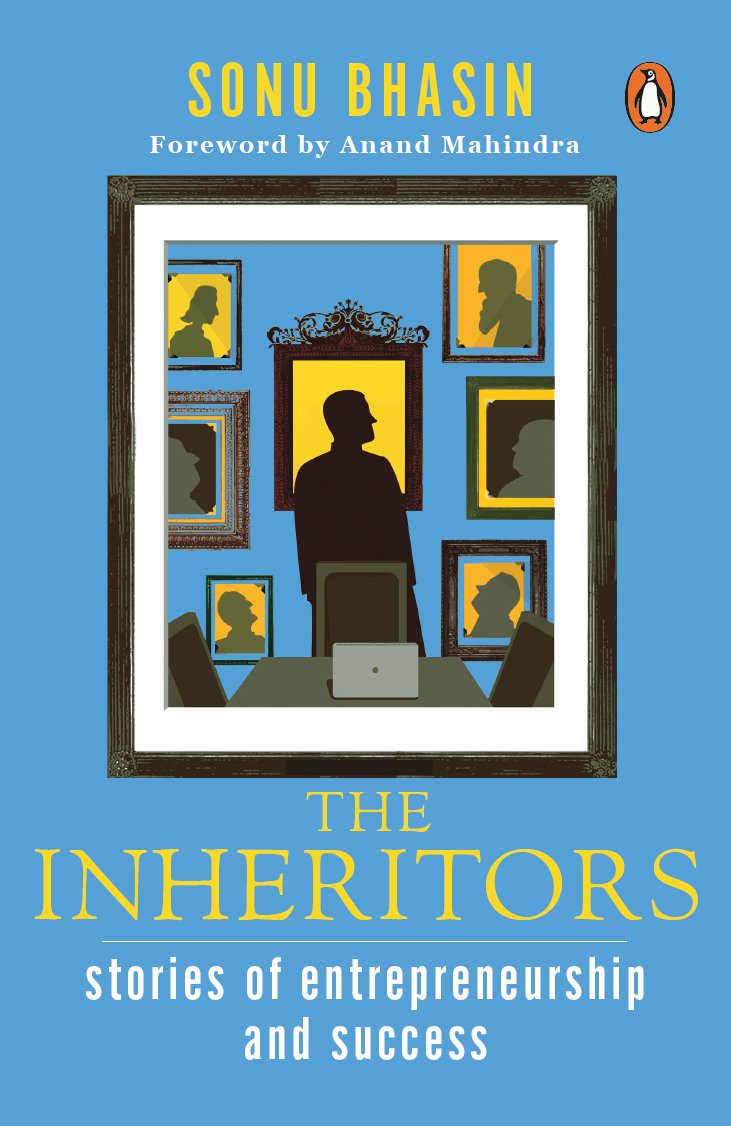
'The Inheritors' book review: Family values seen in entrepreneurship tales


The Inheritors: stories of entrepreneurship and success- Sonu Bhasin


This review was first published in Business Standard on April 06, 2018
inheritors book,family business
Add caption
Penguin Random House India Pvt. Ltd.
7th Floor, Infinity Tower C, DLF Cyber City,
Gurgaon 122 002
First edition (2017)
Rs 299/-

It is easy to feel that the protagonists are sharing their fears and their deepest, heartfelt emotions with readers

Family businesses have been the backbone of the Indian economy since Independence and played a significant role in nation-building even before that.
However, in the era of the Mallyas, Modis and Choksis they have received bad press, a few rotten apples impairing public perception about the rest. Positive stories are hard to come by.

Sonu Bhasin’s The Inheritors fills this gap by narrating the stories of grit, gumption and guts of the next generation of some of India’s well-known family businesses. The exception being Motilal Oswal and Raamdeo Agrawal, who are the founders, not inheritors, of the Motilal Oswal group.

The book is an easy read and the narrative is interesting for the most part, and would engage the layperson as well. The interviews are detailed, insightful and reveal many unknown aspects of the family, the business, successes, failures and strategies. It is easy to feel that the protagonists are sharing their fears and deepest, heartfelt emotions with readers.

Consider the following examples:
Replying to then Hindustan Unilever Chairman Kaki Dadiseth’s overture to Marico to buy out the profitable Parachute brand of hair care products, Harsh Mariwala said, “Mr. Dadiseth, you may think I am a nut but you will find out that I am a tough nut to crack. Thanks, but no thanks”.

Then there is the very human insecurities of a daughter-in-law, now a successful lawyer in her own right, marrying into a prominent family of lawyers. “It was not something that I had ever thought that I would do…I used to look at all the lawyers and my in-laws and feel somewhat intimidated”, said Saloni Shroff who married Rishabh Shroff, the fourth-generation scion of the law firm Amarchand Mangaldas (or Cyril Amarchand Mangaldas as it became after the brothers split in 2015).

Many of the groups and the next-generation leaders whom Ms Bhasin has interviewed for this book are well known and widely covered by the media, so some of the stories may be familiar.

It was refreshing to read about the ones that aren’t as well known- such as Agastya Dalmia of Keventers, a hundred-year-old brand that he revived with two partners, or Arjun Sharma of Select group. Both created new ventures to revive and advance the family business.

The weakness of the book lies in the fact that Ms Bhasin has missed several opportunities that would have given it a longer shelf life. One of them would have been to synthesize the learnings from the leaders’ experiences.

This would have been very helpful for the next generation of the thousands of business families in India. Ms Bhasin also missed the opportunity to weave together a roadmap for the next generation for successfully establishing themselves.

For example, succession challenges plague most family businesses at some point in their life cycle. What was done right in the companies that Ms Bhasin chose for the book?

Another big gap is the lack of an explanation for the choice of companies and leaders featured in the book. Was the choice dictated by convenience, availability or was there a pattern or a logic for selecting the people she did?

To be sure, there are plenty of fascinating stories in the book: The account of Dabur and Amit Burman exemplify professionalisation and separation of ownership from the management; how Pooja Jain found the perfect mentor in her father; why the Dhingras believe that harmony amongst family members is key to the success of the business; how Tara Singh Vachani is proving her mettle through her passion for “senior citizen living”. But why has the writer chosen these groups and not some of the others?

The production also left much to be desired. Pulitzer Prize-winning author Jhumpa Lahiri calls the cover of a book its “clothing”. “If the process of writing is a dream, the book cover represents the awakening,” she writes.

I am not sure if enough thought has gone into designing the cover of the book under review. It is not appealing enough to entice anyone into picking it up at a bookstore. Also, the editing is poor and there are typos. It is to be presumed that these can be taken care of in the future editions and in the digital versions of the book. Lastly, the Foreword by Anand Mahindra could have been longer.

To summarize, the book is well worth a read, not least because with a staggering 90 per cent and more businesses in India being family businesses, success stories need to be told. A little more rigour in the production values and framework may have made it a great book.